
Photo by Aleksandr Popov on Unsplash
The EAEU GMP framework is becoming more demanding for international Pharma & OTC manufacturers. The market covers more than 180 million people, while a EAEU GMP certificate can remain valid for up to 3 years. If critical or material non-conformities are identified, manufacturers have only 60 calendar days to submit their CAPA response.
EAEU GMP Inspections Now Follow a Unified Framework
The EAEU GMP system is now fully unified across the Union, replacing the earlier transition between national and EAEU requirements. Under the official EAEU Pharmaceutical Inspection Rules, inspections follow a common procedure and can be initiated based on an inspection plan, application or request from an authorized EAEU authority. Foreign manufacturing sites therefore need to prepare for EAEU-specific requirements rather than relying only on EU or national GMP standards.
New EAEU GMP Requirements for Sterile Manufacturing
The updated EAEU GMP rules under Decision No. 67 introduce stricter requirements for sterile manufacturing, contamination control and Quality Risk Management.
Most provisions will apply from December 28, 2026, while selected technical requirements have a transition period until June 30, 2029. Manufacturers should therefore review their clean-room controls, microbiological monitoring and Contamination Control Strategy (CCS) before the next EAEU GMP inspection.
The EAEU has also strengthened its approach to microbiological monitoring. Manufacturers should review monitoring programs, sampling plans, alert/action limits and contamination-risk controls before their next inspection.
What Happens After an EAEU GMP Inspection?
The official inspection report is generally prepared within 30 calendar days. Where critical or material findings are identified, manufacturers must submit their CAPA plan, implementation report and supporting evidence within 60 calendar days. Failure to address major findings can result in non-compliant status and refusal or suspension of the GMP certificate.
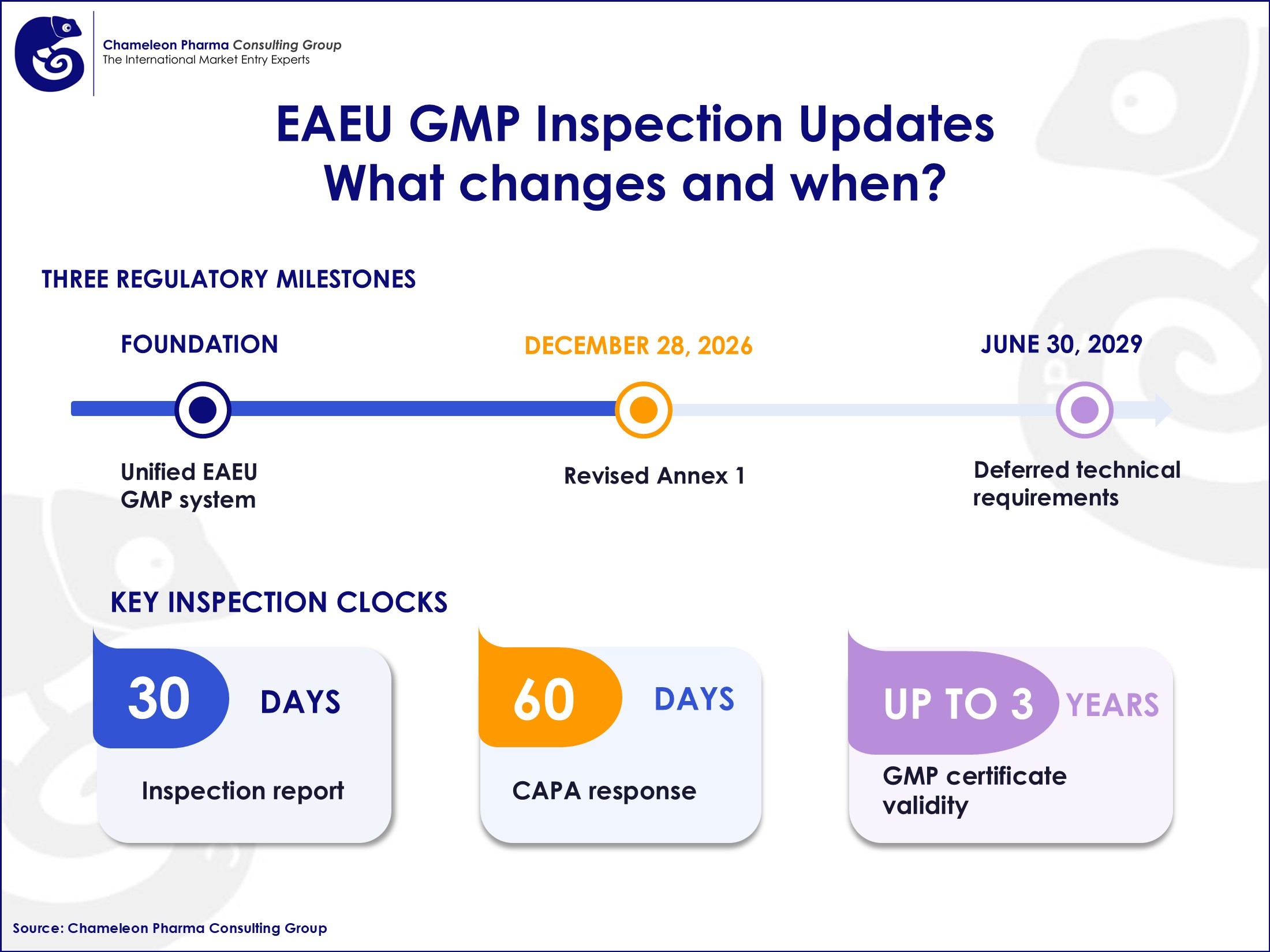
Figure 1: EAEU GMP Inspection Updates
How Can Pharma Manufacturers Reduce EAEU GMP Inspection Risk?
Manufacturers should prepare well in advance of an EAEU GMP inspection by focusing on:
- GAP analysis of the PQS, Site Master File, QA and QC documentation;
- review of sterile-production and contamination-control requirements;
- mock inspection and staff preparation;
- CAPA development and follow-up.
CPC has supported more than 80 successful EAEU and Russian GMP inspections. Our team supports companies with EAEU GMP pre-audits, dossier preparation, inspection coordination and CAPA implementation.
Chameleon Pharma Consulting Group (CPC) has over 20 years of experience in supporting Pharma, OTC, Medical Devices, Phyto, and Aesthetic Medicine companies. Having established own offices & local hubs across Latin America, Europe, Asia, the US/Canada, the Middle East, and the CEE/CIS regions is another advantage of CPC. With this local network and expertise gained from 300+ international projects and a team of 25 experts we offer our clients:
- Market Entry & Expansion: Systematic product and country analysis, market reports
- Strategic Partnering: Identifying local partners, acquisitions, or setting up own offices
- Regulatory & Registration: for drugs, MD, Derma, Aesthetic Medicine, etc.
- Market Authorization & Compliance: Holding MAs, conducting pharmacovigilance
- Quality & Certification: GMP certification, pre-GMP audits
- Business Development, M&A, and Due Diligence
Contact us today for your individual request at service@chameleon-pharma.com!